The right surgeon is not simply the one with the shortest waiting time, lowest fee, or most modern-sounding technique. You need someone who can map the fistula, protect the anal sphincter, explain the trade-offs between procedures, and manage recurrence or underlying Crohn’s disease when those factors apply.
Key takeaways
- Verify registration, qualifications, and anorectal surgery experience independently.
- Ask how the surgeon will map the fistula and protect your anal sphincter.
- Compare procedures by recurrence risk, continence risk, healing time, and follow-up.
- Treat laser as a technique to assess, not proof of superior results.
How do you verify a surgeon’s fistula expertise?
Do not equate the title “general surgeon” with fistula expertise. The best general surgeon for fistula surgery should show specific training in colorectal, proctological, or anorectal surgery and experience protecting the anal sphincter. Verify the surgeon’s registration and qualifications independently through the official medical register and hospital website.
Ask for experience that matches your problem, not a total surgical case count. A surgeon who treats simple, low fistulas may not routinely manage high, branching, recurrent, postoperative, or Crohn’s-related fistulas. Ask how many similar cases they personally treat and which sphincter-sparing procedures they perform.
Use these questions during the consultation:
- How do you classify my fistula as simple or complex?
- How often do you treat recurrent or sphincter-involving anal fistulas?
- Which treatment would you use if dividing the sphincter threatened continence?
- Do you personally perform staged treatment with a draining seton or other sphincter-sparing approaches?
- Where would the operation take place, and do you have operating and admitting rights there?
- Will a qualified anaesthetist support the procedure, including examination under anaesthesia when needed?
- Can you arrange pelvic MRI, specialist imaging, or gastroenterology referral if Crohn’s disease is suspected?
A strong answer explains how the surgeon will manage recurrence rather than promising a single guaranteed cure. Search ranking or a clinic’s location cannot establish who is the best fistula specialist.
How does fistula anatomy determine the operation?
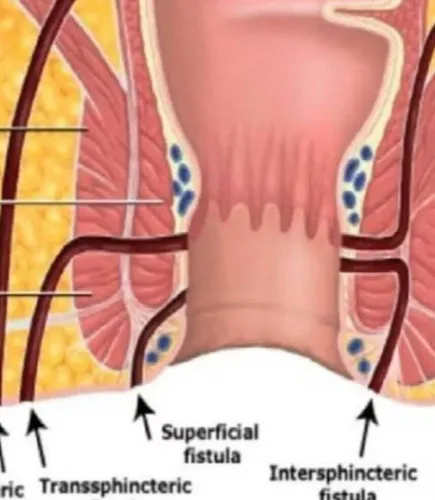
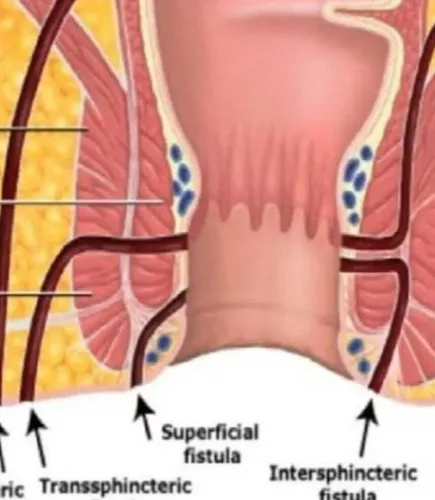
The operation depends on how much anal sphincter the tract crosses, not simply on where drainage appears. A fistula treatment surgeon should map the external opening, internal opening, main tract, branches, abscess cavities, and sphincter involvement before recommending treatment.
1. Record the openings and tract direction. A skin opening alone cannot reveal whether the fistula runs superficially, between the sphincter muscles, or through them.
2. Classify the tract by sphincter involvement. A low, straight tract crossing little muscle is different from a high or trans-sphincteric tract that passes through a substantial portion of the external sphincter.
3. Check complexity and continence risk. Recurrent disease, branching or horseshoe extensions, multiple openings, Crohn’s disease, previous operations, existing leakage, and an anterior fistula in a woman all demand greater caution.
4. Match the operation to the risk. Fistulotomy often suits a simple low tract because opening it sacrifices little muscle. A high or complex tract may call for a draining seton followed by LIFT, an advancement flap, or another sphincter-preserving plan rather than immediate division.
An experienced surgeon should explain the classification in plain language and state whether treatment is definitive or staged.
| Anatomy | What it usually indicates | Treatment implication |
|---|---|---|
| Low, simple tract | Little sphincter involved | Fistulotomy may be suitable |
| High or trans-sphincteric tract | More sphincter lies across the tract | Protect continence with a sphincter-sparing or staged approach |
| Branching, recurrent, or horseshoe tract | Complex anatomy or persistent disease | Map extensions before selecting treatment |
Which examinations, scans, and consultation questions matter?
A draining external opening does not show the full tract. A clinical examination can be enough for a straightforward, first-time fistula, while proctoscopy helps inspect the anal canal for an internal opening or additional disease. Ask the surgeon to document both openings, secondary extensions, and the sphincter muscle involved.
Ask these questions before agreeing to surgery:
- What classification does the fistula have, and which part crosses the sphincter?
- How did you identify the internal opening?
- Is the proposed operation definitive, or is it the first stage of treatment?
- How will you assess my continence risk, including existing urgency, leakage, or prior sphincter injury?
- What will you do if MRI or examination under anaesthesia reveals another tract?
| Examination or scan | What it clarifies | When it is useful |
|---|---|---|
| Clinical examination | External opening, tenderness, drainage, and likely tract direction | Straightforward, first-time fistula |
| Proctoscopy | Anal-canal inflammation or a visible internal opening | When external inspection is incomplete |
| Examination under anaesthesia | Tract and openings without pain-driven muscle tightening; avoids forceful probing while awake | Unclear, painful, complex, or recurrent disease |
| Pelvic MRI | Secondary tracts, abscesses, and deep extensions | Occult, recurrent, complex, or Crohn’s-related fistula |
| Endoanal ultrasound | Sphincter structure and defects | Continence concerns or previous anal surgery |
A fistula surgeon in Vikhroli should explain why a test is needed rather than ordering every scan routinely. Compare the reasoning, continence plan, and fallback if the fistula returns—not only the quoted fee.
How should you compare procedures, laser claims, and recovery?
A fistula treatment surgeon should compare the operation against your continence risk, not promise the fastest closure. Ask whether the plan is definitive or staged, how recurrence will be handled, and how much sphincter muscle the procedure divides.
| Option | Sphincter risk | Healing, recurrence, and number of procedures | Practical recovery |
|---|---|---|---|
| Fistulotomy | Low for a superficial tract; higher when more sphincter is divided | Often one operation; the open groove heals gradually, but recurrence follows if the tract is missed | Regular washing, dressings, drainage management, and time off work based on wound size |
| Loose seton | Preserves muscle and drains infection; it does not usually cure the tract | Often the first stage before LIFT or a flap; recurrence remains possible if no definitive treatment follows | Ongoing string care, discharge, follow-up visits, and a second procedure |
| Cutting seton | Divides muscle slowly, so continence risk requires careful discussion | Can treat selected tracts over several visits; healing and recurrence vary | Repeated tightening or review, discomfort, wound care, and potentially extended work disruption |
| LIFT | Designed to avoid cutting the main sphincter | Usually one planned definitive procedure after drainage; healing and recurrence vary by anatomy | Smaller wound care burden than an open fistulotomy, but follow-up remains necessary |
| Advancement flap | Avoids deliberate sphincter division but is technically demanding | One operation in many cases; failure can require another procedure | Protect the flap, manage drainage, and expect recovery limits |
| Staged surgery | Spreads sphincter risk across planned steps | More than one procedure, with recurrence assessed after each stage | More appointments, wound care periods, and cumulative time away from work |
“Laser” describes a technique, not proof of lower recurrence or safer continence outcomes. Ask which tract features justify it, what evidence the surgeon uses, and what happens if the external opening closes while the internal opening remains.
How do you choose between surgeons in Vikhroli?
Choose the surgeon who gives you a specific, anatomy-based plan—not the one offering the lowest fee or shortest recovery estimate. At a local consultation, ask two surgeons to review the same examination findings or MRI, mark the internal opening and sphincter involvement, and explain what happens if the tract branches.
Ask both surgeons:
- Is the proposed operation definitive, or is it the first stage of treatment?
- If you need a draining seton first, what decides when the next procedure will occur?
- How will you assess continence risk, and what is the plan if urgency or leakage follows surgery?
- What will you do if the fistula returns, becomes recurrent, or proves postoperative?
| Plan | What to verify | Main trade-off |
|---|---|---|
| One-stage fistulotomy | Suitable only when dividing the tract will not threaten important sphincter muscle | Definitive treatment in selected anatomy, but greater continence risk when the tract is deeper |
| Draining seton followed by LIFT or advancement flap | The first operation controls drainage and the second aims to close the tract while preserving the sphincter | Lower immediate sphincter division, but more visits, healing time, and possible recurrence |
A recurrent, multiple, branching, or postoperative fistula deserves a wider assessment. Ask whether the surgeon is considering Crohn’s disease when you have diarrhoea, abdominal symptoms, or other perianal disease; abscess drainage and gastroenterology coordination can matter more than repeated surgery alone.
If you consult ChirayuHealthcare Polyclinic&Diagnostics, request the written diagnosis and treatment plan so you can compare it directly with another fistula surgery doctor in Vikhroli or fistula surgeon in Vikhroli. Search ranking and clinic location do not establish operative expertise.
Related service
Fistula Surgery we are specialized in complex fistula surgeries View service → |
Frequently asked questions
How do you verify a surgeon’s fistula expertise?
Check the surgeon’s registration and qualifications through the official medical register and hospital website. Ask about specific training in colorectal, proctological, or anorectal surgery, annual fistula caseload, recurrence rates, and experience protecting the anal sphincter.
How does fistula anatomy determine the operation?
The tract’s location, internal opening, relation to the anal sphincter, branching, and presence of abscess determine treatment. A low tract may suit fistulotomy, while a high or complex tract may require a sphincter-preserving procedure.
Which examinations, scans, and consultation questions matter?
The consultation may include a perianal examination, digital rectal examination, and proctoscopy. MRI pelvis or endoanal ultrasound can map complex or recurrent fistulas. Ask which muscles the operation will divide, the expected healing time, recurrence risk, continence risk, and follow-up plan.
How should you compare procedures, laser claims, and recovery?
Compare fistulotomy, seton placement, LIFT, advancement flap, and other options by anatomy, healing time, recurrence, continence risk, and evidence. Laser is a technique, not proof of better outcomes; ask for procedure-specific results and clear follow-up arrangements.