Persistent discharge, a new opening, swelling or pain after fistula treatment needs reassessment, not an assumption that haemorrhoids have returned. You will learn which symptoms need urgent care, what tests can map a recurrent tract, and how to compare treatment plans without overlooking continence risk or Crohn’s disease.
Key takeaways
- Seek urgent assessment for a growing lump, fever, chills, or spreading redness.
- Antibiotics cannot replace drainage when an anorectal abscess is present.
- Ask how the fistula tract affects continence risk and procedure choice.
- Bring previous surgical records, imaging reports, and a symptom timeline.
When returning fistula symptoms need urgent assessment
A painful lump that is enlarging near the anus, especially with fever or chills, needs urgent medical assessment. An anorectal abscess can worsen quickly, and antibiotics alone do not replace drainage when an abscess is present. Do not wait for a routine appointment if you feel faint, cannot pass urine, or redness is spreading.
If you are searching for “fistula specialist near vikhroli symptoms return” after treatment, use these signs to decide how quickly to seek care:
- Same-day assessment: rapidly increasing pain, swelling, pus, fever, chills, spreading redness, difficulty passing urine, or feeling faint.
- Prompt specialist review: persistent discharge, a new opening near the anus, repeated bleeding, or pain that returns after it had settled.
- Mention immediately: multiple fistulas, diarrhoea, abdominal pain, weight loss, non-healing wounds, or perianal skin tags. These can point to Crohn’s disease or another condition requiring gastroenterology and colorectal assessment.
| Symptom pattern | What it may indicate | Action |
|---|---|---|
| Rapid pain and swelling with fever | Abscess or recurrent infection | Seek same-day medical assessment |
| New opening or ongoing pus without systemic illness | Recurrent or branching fistula | Arrange prompt specialist review |
| Itching, soreness, or light drainage from a healing wound | Delayed healing or scar irritation | Follow the surgical team’s instructions unless it worsens |
| Sharp pain during bowel movements with little swelling | Anal fissure or another condition | Book an assessment; seek urgent care if fever or swelling develops |
Do not assume returning symptoms are haemorrhoids. Take your operative notes, scans, discharge summaries, medication list, and continence or bowel-symptom history to the appointment.
Why a fistula can return after treatment
A fistula can return when a residual tract, missed internal opening, side branch, or horseshoe extension remains after treatment. Inadequate drainage, premature closure of the skin opening, Crohn’s disease, or a tract deliberately left partly untreated to protect the sphincter can also cause renewed symptoms.
A loose seton controls drainage but does not necessarily eliminate the fistula, so ask whether it is temporary, part of staged treatment, or long-term management.
Normal healing usually produces decreasing wound discomfort, itching, and a small amount of drainage. Recurrent disease becomes more likely when symptoms follow a settled period or drainage repeatedly stops and restarts.
- A new or reopening opening near the anus, persistent pus, repeated swelling, or pain in the same area supports reassessment for a recurrent tract or abscess.
- Sharp pain during or after passing stool points more toward an anal fissure.
- Bright-red bleeding, itching, or a lump can come from haemorrhoids, while several boil-like openings may indicate hidradenitis or pilonidal disease.
| Pattern | More likely explanation | What to do |
|---|---|---|
| Ongoing, reducing discharge after surgery | Healing wound | Follow the surgeon’s wound-care plan |
| Repeated discharge, swelling, or a new opening | Residual or recurrent fistula | Arrange examination; recurrent fistula treatment may require imaging or staged care |
| Sharp stool-related pain or a superficial lump | Fissure or haemorrhoid | Request a focused anorectal examination |
A pelvic MRI or examination under anaesthesia can locate hidden branches when symptoms persist or recur.
What happens during a fistula surgery consultation
A fistula surgery consultation starts with inspection of the skin and openings, a digital rectal examination, and often anoscopy. The specialist looks for pus, tenderness, swelling, scar tissue, a visible external opening, and the likely internal opening; probing must be gentle because force can create a false passage.
A search for fistula specialist near vikhroli symptoms return should lead to reassessment, not an assumption that haemorrhoids caused the problem. At ChirayuHealthcare Polyclinic&Diagnostics, ask how recurrent cases are mapped before another procedure is chosen.
Bring these details:
- Previous operative notes, discharge summaries, imaging reports and actual scan images
- The date symptoms returned, persistent discharge, a new opening, swelling, pain, fever or bleeding
- Current medicines, antibiotic courses, diabetes history and allergies
- Any leakage of gas or stool, urgency, constipation or diarrhoea
- Repeated fistulas, poor wound healing, abdominal pain, weight loss or perianal skin tags, which can point toward Crohn’s disease
| Test or examination | What it shows | When it is useful |
|---|---|---|
| Pelvic MRI | Primary tract, side branches, horseshoe extensions and internal opening | Recurrent or complex fistula, especially after surgery or when the external opening is misleading |
| Endoanal ultrasound | Tract position and anal-sphincter involvement | Defining anatomy near the sphincter when ultrasound expertise is available |
| Examination under anaesthesia | A pain-free, thorough examination and careful tract assessment | Severe tenderness, unclear anatomy or suspected complex disease; it may allow drainage or treatment planning during the same session |
Related service
Fistula Surgery we are specialized in complex fistula surgeries View service → |
How fistula anatomy changes the treatment choice
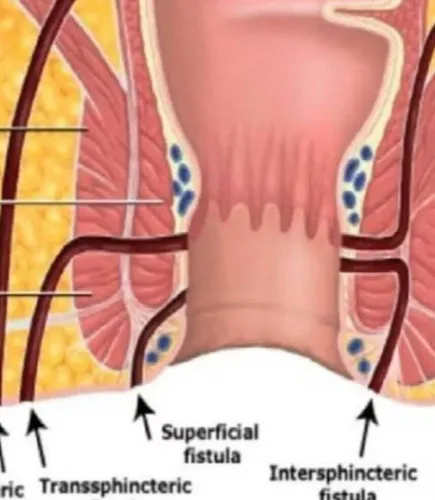
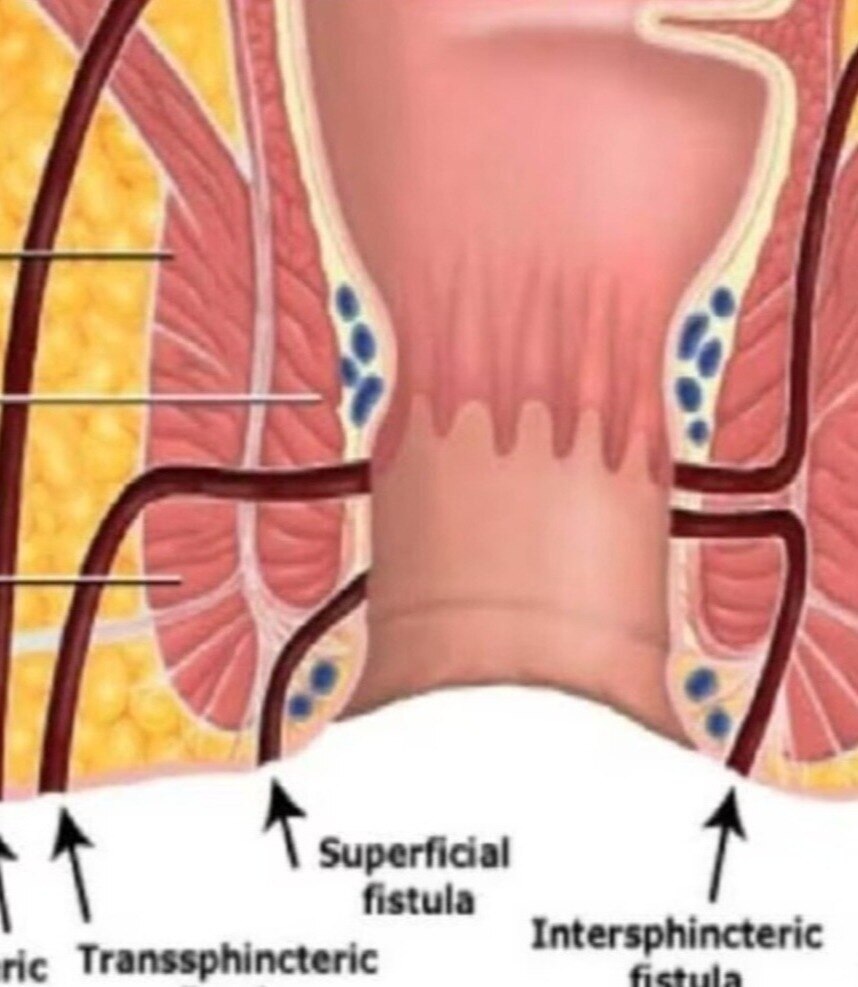
The key decision is how much of the anal sphincter the tract crosses. Surgeons classify fistulas as intersphincteric, transsphincteric, suprasphincteric or extrasphincteric; a transsphincteric fistula is also described as low or high according to the amount of external sphincter involved.
- Intersphincteric: runs between the internal and external sphincters.
- Low transsphincteric: crosses a small portion of the external sphincter.
- High transsphincteric or suprasphincteric: crosses, or curves above, more sphincter muscle.
- Extrasphincteric: lies outside the usual sphincter route and needs careful investigation.
| Option | Main benefit | Main trade-off |
|---|---|---|
| Drainage or loose seton | Controls pus and reduces abscess risk while keeping the tract open | Usually does not remove the fistula; it may be temporary, staged or long-term |
| Fistulotomy | Opens the tract for healing and is often the most definitive option for a simple, low fistula | Dividing more sphincter raises the risk of impaired continence |
| Sphincter-preserving procedure | Protects muscle using methods such as LIFT or an advancement flap | Healing rates vary, and more than one procedure may be needed |
A recurrent or high tract demands more caution than a first, low tract. Baseline continence, previous operations, obstetric injury, sex, and Crohn’s disease can change the safest choice. Pelvic MRI helps map branches, horseshoe extensions and a hidden internal opening before recurrent fistula treatment.
For fistula treatment near Vikhroli, ask whether the surgeon regularly manages complex recurrence, can arrange MRI and examination under anaesthesia, and will explain both continence risk and staged alternatives.
How to compare a nearby specialist and prepare for follow-up
Do not choose a fistula surgeon nearby only because the clinic is convenient. Ask how frequently they treat recurrent or complex fistulas, whether they can arrange pelvic MRI and examination under anaesthesia, and how they will protect continence before recommending another operation.
Take these records to an appointment for fistula treatment near vikhroli:
- Previous operative notes, discharge summaries and wound-care instructions
- MRI, ultrasound, examination-under-anaesthesia reports and image discs
- Current medicines, allergies, antibiotic courses and medical conditions
- A dated note describing drainage, pain, swelling, bowel movements and continence
- Any history of diarrhoea, weight loss, mouth ulcers or suspected Crohn’s disease
Compare the surgeon’s answers on these points:
| Criterion | Ask | Why it matters |
|---|---|---|
| Experience | How many recurrent or complex fistulas do you manage? | Familiarity with branching tracts reduces reliance on a superficial opening. |
| Mapping | Do I need pelvic MRI or examination under anaesthesia before surgery? | Imaging can reveal a missed internal opening, side branch or horseshoe extension. |
| Procedure | Is this drainage, fistulotomy, or a sphincter-preserving plan? | The operation must balance cure against continence risk. |
| Seton | Is the loose seton temporary, staged, or long-term? | A seton controls drainage but does not necessarily eradicate the fistula. |
| Follow-up | When will you check healing, drainage and continence, and what symptoms require an earlier review? | A closing skin opening can hide infection deeper inside. |
Ask who reviews persistent discharge, a new opening or renewed swelling, and what test or treatment follows if symptoms continue. A repeat procedure should follow renewed diagnosis, not automatically copy the first operation.
Frequently asked questions
When do returning fistula symptoms need urgent assessment?
Seek urgent medical assessment for an enlarging painful lump, fever, chills, spreading redness, faintness, or difficulty passing urine. An abscess needs drainage when present.
Why can an anal fistula return after treatment?
A fistula can recur when an internal opening remains, a side branch was missed, healing is incomplete, or a new abscess forms.
What happens during a fistula surgery consultation?
The surgeon reviews your symptoms and previous treatment, examines the area, assesses continence risk, and decides whether imaging or examination under anaesthesia is needed.
How does fistula anatomy affect treatment choice?
The tract’s position and how much sphincter muscle it crosses help determine whether fistulotomy, seton placement, or a sphincter-sparing procedure is safer.