

Medicines can settle infection and reduce symptoms, but they rarely close an established anal fistula. By comparing drainage, medical treatment and sphincter-preserving operations, you can identify when a general surgeon is suitable, when specialist assessment matters and which questions reveal whether a proposed treatment fits your anatomy.
Key takeaways
- Medicines rarely close an established anal fistula without surgery.
- MRI pelvis or examination under anaesthesia can map complex fistula tracts.
- Fistulotomy suits selected simple fistulas; sphincter-saving procedures protect continence.
- Crohn’s disease often requires medicines alongside drainage or staged surgery.
Can medicines cure an anal fistula, or is surgery usually needed?
Surgery is usually needed for an anal fistula; medicines alone rarely cure it. After an abscess drains, an epithelialised tract can remain between the anal canal and skin. Antibiotics, pain relief, creams and symptom control may reduce infection or discomfort, but they rarely close this established tract.
The choice between fistula surgery or conservative treatment with a general surgeon should therefore begin with confirming whether you have an abscess, a fistula or both.
An abscess and a fistula need different treatment. A painful, drainable abscess generally requires prompt incision and drainage. Antibiotics are added for fever, spreading cellulitis, systemic infection, immunosuppression or another high-risk circumstance; they are not a substitute for draining pus.
Seek urgent assessment for:
- Fever or pus with systemic illness
- Rapidly worsening anal pain
- Spreading redness or swelling
- Difficulty passing urine
- Inability to pass stool
A loose seton can keep a fistula draining and reduce the risk of another abscess while the anatomy is assessed or later treatment is planned. It is not automatically a cure. Ask whether the seton is intended for drainage or will be tightened as a cutting seton, because these are different strategies.
Persistent discharge needs reassessment, not indefinite cream use or an assumption that it is haemorrhoids.
How does a general surgeon map the fistula before recommending treatment?
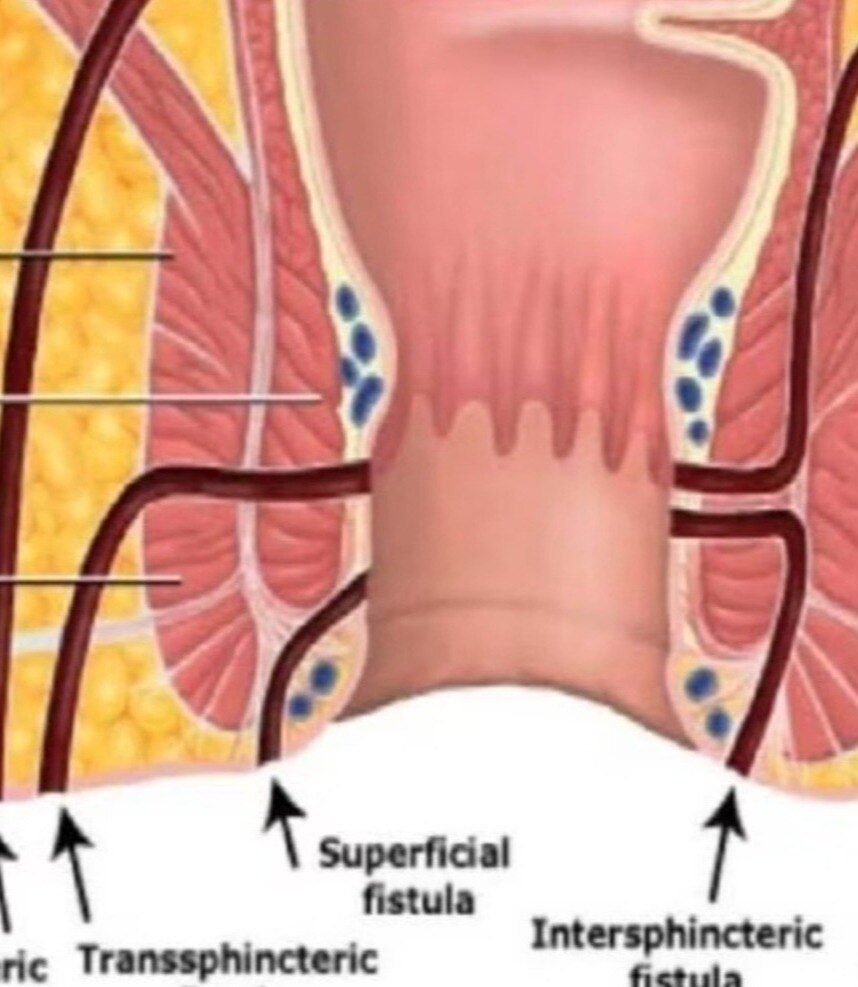
A general surgeon for fistula maps the tract before choosing between fistulotomy, drainage, or a sphincter-preserving procedure. The visible skin opening does not reliably show where the tract enters the anal canal or how much sphincter muscle it crosses.
- The surgeon records discharge, bleeding, pain, swelling, previous abscesses, operations, recurrence and continence symptoms.
- Inspection identifies the external opening, scars, induration and any second opening.
- A digital rectal examination assesses tenderness, a cord-like tract, masses and sphincter tone.
- Proctoscopy is used when appropriate to look for the internal opening or another rectal cause of symptoms.
An office examination may fail when pain prevents relaxation, scarring distorts the anatomy, or the internal opening remains uncertain. Examination under anaesthesia allows a more reliable assessment without discomfort limiting the search.
Routine imaging is not needed for every obvious, simple, low fistula. MRI pelvis with a fistula protocol or endoanal ultrasound adds value for recurrent disease, branching or horseshoe tracks, high fistulas, multiple external openings and Crohn’s-associated disease.
Complex features include a high trans-sphincteric or suprasphincteric track, an anterior fistula in a woman, previous operations, prior continence problems and inflammatory bowel disease. As the risk to the sphincter rises, detailed anatomy mapping becomes more important than relying on the external opening alone.
Which operation fits a simple fistula, and when is sphincter preservation safer?
For a carefully selected simple, low fistula, fistulotomy usually fits: the surgeon lays the tract open and avoids dividing a damaging amount of sphincter. It is not the safest default for every patient.
If too much external sphincter is cut, continence can worsen. Before choosing fistulotomy, assess baseline continence, previous fistula operations, obstetric injury and the amount of sphincter involved.
| Option | What it does | Main trade-off |
|---|---|---|
| Fistulotomy | Lays the tract open | Strong option for simple, low fistulas; unsafe when sphincter division is substantial |
| Loose draining seton | Keeps the tract open and controls sepsis | Preserves future choices but is not necessarily a cure |
| Cutting seton | Tightens gradually through the fistula tissue | Deliberately divides tissue and has different continence implications |
| LIFT | Closes the tract between the sphincter muscles | Preserves the sphincter, but healing is less predictable |
| Endorectal advancement flap | Covers the internal opening with rectal tissue | Avoids deliberate sphincter division, yet recurrence can occur |
A loose seton can prevent another abscess while the anatomy is clarified or a later operation is planned. Ask whether a proposed seton is for drainage or will be tightened as a cutting seton.
For substantial sphincter involvement, LIFT or an endorectal advancement flap may be safer. Fibrin glue, fistula plugs and laser-labelled procedures are not guaranteed replacements; results vary, and more than one operation may be needed.
When does medical treatment belong alongside surgery, especially with Crohn’s disease?
Fistula surgery versus medicine is not a genuine either-or decision in perianal Crohn’s disease. Treatment often combines abscess drainage, a loose seton when indicated and Crohn’s-directed medication, such as biologic therapy, to control both the tract and the underlying inflammation.
| Option | Main role | What it cannot reliably do |
|---|---|---|
| Drainage | Treats an abscess and uncontrolled infection | Does not usually close a persistent fistula tract |
| Loose seton | Keeps the tract draining and helps prevent another abscess | Is not automatically a cure |
| Antibiotics | Supports infection control | Usually does not eradicate an established tract |
| Biologic therapy | Treats Crohn’s inflammation and may support fistula control | Does not replace drainage of an abscess |
Do not start immunosuppressive treatment for a suspected perianal abscess until adequate drainage has occurred and uncontrolled sepsis has been excluded. Delaying drainage while relying on medicine can allow infection to spread.
Smoking, poor nutrition, uncontrolled diabetes, immunosuppression and active inflammatory bowel disease can impair healing or increase recurrence risk. Correcting these problems improves treatment planning, but does not usually close the fistula by itself.
Recurrence remains possible. Seek reassessment for persistent drainage, a new painful swelling, fever or a new opening. After repeat operations, continence symptoms can become more noticeable, so baseline continence and prior procedures belong in the treatment discussion.
How should you choose a surgeon and compare treatment plans in Mumbai?
Choose the plan that explains your anatomy and continence risk, not the search label “fistula specialist in Mumbai” or “complex fistula surgeon near me.” Colorectal or proctological fistula experience matters more than the generic label “general surgeon” or a “minimally invasive” claim.
Ask these questions before agreeing to treatment:
- How is the tract classified: low, high, trans-sphincteric, suprasphincteric, branching or recurrent?
- Do I need pelvic MRI with a fistula protocol or examination under anaesthesia?
- How much anal sphincter does the tract involve?
- If fistulotomy is unsafe, what continence-preserving alternative fits my anatomy?
- Is the proposed seton loose for drainage, or a cutting seton intended to tighten through tissue?
- What happens if the fistula recurs, and who coordinates care if Crohn’s disease is suspected?
| Plan | Main purpose | What to clarify |
|---|---|---|
| Fistulotomy | Opens a simple, low tract | How much sphincter will be divided? |
| Loose seton | Maintains drainage and controls sepsis | Is it temporary or long-term? |
| Cutting seton | Gradually divides the tract | What is the continence risk? |
| LIFT or advancement flap | Preserves more sphincter | Why is this preferable in my case? |
A Mumbai consultation at ChirayuHealthcare Polyclinic&Diagnostics can review examination findings, imaging needs and continence concerns, then distinguish surgical, drainage or coordinated medical care. The goal is an anatomy-based plan, not a promise that one procedure suits every fistula.
Related service
Fistula Surgery we are specialized in complex fistula surgeries View service → |
Frequently asked questions
Can medicines cure an anal fistula, or is surgery usually needed?
Medicines can control pain, inflammation or infection, but they rarely close an established epithelialised fistula tract. Surgery is usually needed after any active abscess is treated.
How does a general surgeon map an anal fistula before treatment?
The surgeon examines the external opening, checks for abscesses and assesses sphincter involvement. Complex or recurrent fistulas may require MRI pelvis or examination under anaesthesia.
Which operation fits a simple fistula?
A fistulotomy can suit a low, simple fistula that crosses little sphincter muscle. The surgeon should recommend a sphincter-preserving option when cutting the tract could affect continence.
When does medical treatment belong alongside fistula surgery?
Crohn’s disease can cause persistent or multiple fistulas, so treatment may combine drainage or staged surgery with medicines prescribed by a gastroenterologist.
How should you compare fistula treatment plans in Mumbai?
Ask a general surgeon to explain the tract anatomy, proposed procedure, continence risk, healing time, recurrence plan and whether MRI, colorectal input or gastroenterology care is needed.