

A recurring opening near the anus, pus or blood discharge, and swelling that settles before returning can indicate an anal fistula rather than piles or a temporary skin problem. You will learn how urgently to seek care, how specialists map the tract, which operations protect the sphincter, and how to compare clinical suitability with actual surgical availability near Chembur.
Key takeaways
- Seek urgent care for fever, spreading redness, severe pain, or difficulty passing urine.
- MRI pelvis can map a complex fistula before surgery.
- Choose fistulotomy only when the tract crosses little or no sphincter muscle.
- Confirm surgeon availability, imaging, fees, wound care, and follow-up before booking.
Could these symptoms be an anal fistula, and when is care urgent?
An anal fistula is a persistent tunnel from inside the anus to skin nearby, usually left after a perianal abscess. Look for a recurring skin opening, pus or blood, foul-smelling drainage, repeated swelling and pain. The swelling may settle after it drains, then return.
| Condition | Typical pattern |
|---|---|
| Anal fistula | Repeated drainage from the same skin opening, often after an abscess |
| Haemorrhoids | Bright-red bleeding or a lump linked to bowel movements, without a persistent opening |
| Anal fissure | Sharp, tearing pain during or after passing stool, often with a small amount of blood |
| Pilonidal sinus | Opening or discharge in the cleft near the tailbone, not beside the anus |
| Perianal abscess | New, intensely painful, tender swelling; it is an acute infection, not automatically a fistula |
A fistula that stops draining is not necessarily cured. The skin opening can close while the tract or a trapped abscess remains, causing renewed swelling and pain. An acute fluctuant abscess needs prompt drainage; antibiotics alone do not replace drainage.
Seek urgent assessment for fever, rapidly increasing pain or swelling, spreading redness, difficulty passing urine, severe bleeding, faintness or immunosuppression. Do not wait for an elective appointment found by searching fistula surgeon chembur; local search results cannot triage a potentially worsening infection. Even without emergency signs, arrange colorectal assessment for recurring discharge or swelling.
How does a specialist confirm the tract and classify its risk?
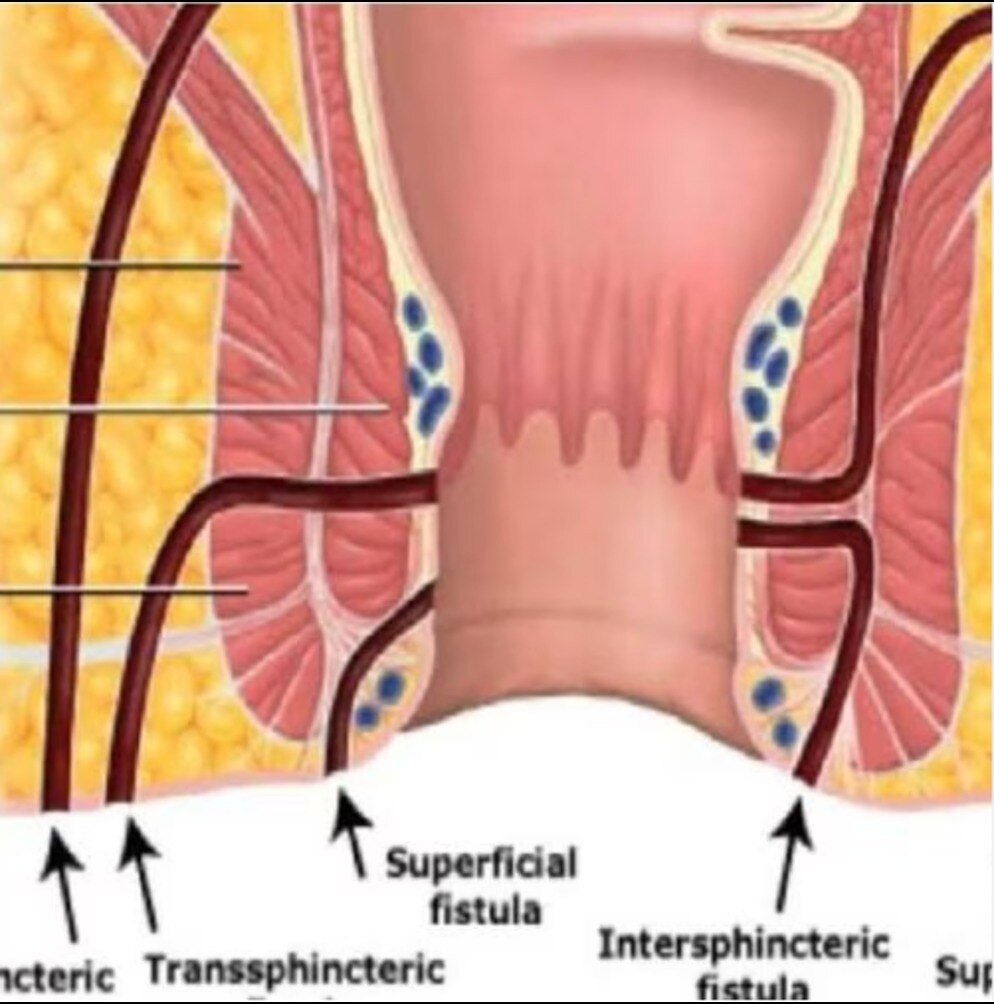
Confirmation starts by identifying the external opening, the small hole on the skin, and the internal opening inside the anal canal. The fistula tract is the abnormal tunnel joining them; the key risk is how much of the anal sphincter muscles it crosses, because cutting muscle can affect continence.
The specialist asks about previous abscess drainage or fistula surgery, recurring swelling, discharge, bowel symptoms and control of gas or stool. Mention a previous obstetric sphincter injury where relevant. Diarrhoea, abdominal pain, weight loss, multiple fistulas or other perianal disease can point to Crohn’s disease and require further evaluation.
A careful inspection, gentle digital examination and proctoscopy may locate the openings. Examination under anaesthesia helps when pain prevents an adequate examination or the internal opening and branches remain unclear.
Endoanal ultrasound can show the tract’s relationship to the sphincter, while pelvic MRI is particularly useful for recurrent, complex, occult or Crohn’s-related disease because it maps branches and hidden abscesses. Routine imaging is unnecessary for every obvious, low, simple fistula.
| Type | Features | Why it matters |
|---|---|---|
| Simple | Low, single tract with little sphincter involvement | Fistulotomy may be suitable |
| Complex | High tract or substantial sphincter involvement | Muscle-preserving planning is important |
| Complex | Branches, horseshoe extension, multiple openings or abscess | MRI and staged treatment may be needed |
| Complex | Recurrence, inflammatory bowel disease or radiation-related disease | Healing and continence risks require specialist planning |
Which operation fits the fistula without trading away continence?
Fistula surgery in Mumbai is not one standard operation: the tract’s height, sphincter involvement, branches, recurrence, continence and underlying disease determine the safest choice. The central trade-off is healing versus muscle preservation. Fistulotomy can heal a low, simple tract reliably, but dividing muscle in a high tract can impair continence.
| Option | What it tries to achieve | Main limitation |
|---|---|---|
| Fistulotomy | Opens the tract to heal from the base | Unsafe when substantial sphincter muscle is involved |
| Draining seton | Keeps infection draining while protecting muscle | Controls rather than cures the fistula; later surgery may be needed |
| LIFT or advancement flap | Closes the internal opening while dividing little or no sphincter | Primary healing is less predictable, with possible recurrence |
| FiLaC or similar laser closure | Seals the tract without deliberately cutting muscle | Evidence varies, and recurrence remains possible |
A seton can remain for weeks or longer before staged surgery. Advancement flap, LIFT and other sphincter-preserving approaches accept a greater chance of repeat treatment to reduce continence risk.
High, recurrent, branching or horseshoe fistulas need careful mapping and often staged treatment rather than one definitive operation. Crohn’s-related fistulas also require control of inflammation alongside drainage or closure; operating on active disease alone can fail.
Ask which muscle is crossed, what healing and recurrence risks apply to your anatomy, and what happens if the first procedure does not close the tract.
How should you compare a fistula specialist’s availability near Chembur?
An available appointment is not proof of a suitable operation. For fistula specialist surgery for availability chembur, compare clinical suitability and logistics separately.
| Factor | What to verify | Why it matters |
|---|---|---|
| Colorectal expertise | Documented colorectal training and experience with complex and recurrent fistulas | A high, branching or recurrent tract needs more than a “fistula surgeon” label |
| Operating responsibility | The named surgeon who will operate or directly supervise the procedure | A consultation may be with someone who will not perform the surgery |
| Anatomy assessment | Sphincter involvement, internal and external openings, branches and abscesses; access to pelvic MRI or examination under anaesthesia | Fistulotomy can threaten continence when too much muscle is divided |
| Treatment setting | Anaesthesia, hospital admission, pathology and supporting diagnostics | Missing arrangements can delay surgery or leave complications poorly assessed |
Ask the complex fistula specialist for a case-specific estimate of healing, recurrence and continence risk. Reject a laser-only promise: FiLaC or another laser technique is not automatically safer or more effective for your anatomy.
Before booking, confirm the earliest consultation date, expected review schedule and an emergency contact route for fever, worsening pain, bleeding or urinary difficulty. Ask who manages after-hours problems and whether follow-up occurs with the operating surgeon.
ChirayuHealthcare Polyclinic&Diagnostics may help coordinate local consultation and diagnostics, but confirm each service separately. Availability near Chembur does not establish that the surgeon or proposed treatment suits your sphincter anatomy.
Related service
Fistula Surgery we are specialized in complex fistula surgeries View service → |
What should you settle before booking surgery and follow-up?
Bring every record that can change the operation: previous fistula or abscess-drainage notes, operation reports, imaging discs and reports, a complete medication list, and details of any obstetric sphincter injury. Record continence symptoms, diarrhoea, abdominal pain or weight loss, plus the exact pattern of discharge, bleeding, swelling and pain.
Ask the surgeon to explain:
- Where the internal and external openings are.
- How much sphincter muscle the tract crosses.
- Whether branches, a horseshoe extension or an abscess are present.
- Why the proposed procedure suits your anatomy, and which alternatives were rejected.
- How long a seton would remain if used.
- What anaesthesia, wound care, restrictions and review schedule apply.
- How recurrence will be investigated, and when MRI, repeat examination or examination under anaesthesia would be needed.
- How Crohn’s disease assessment will be arranged if bowel or systemic symptoms are present.
A credible plan connects findings to treatment rather than promising a generic success rate.
| Option | What to settle | Why it matters |
|---|---|---|
| Fistulotomy or sphincter-sparing procedure | Exact procedure and alternatives | Muscle division affects continence risk |
| Seton | Purpose and expected duration | Drainage and staged treatment need monitoring |
| Follow-up | Review date and emergency contact route | A closed opening can hide persistent disease |
Choose the earliest appropriate assessment for an urgent problem, but do not choose a surgeon solely because an appointment is available. Balance speed, colorectal experience, anatomy-based planning and a clear continence-preservation strategy.
Frequently asked questions
Could these symptoms be an anal fistula, and when is care urgent?
A recurring skin opening near the anus, pus or blood, foul-smelling drainage, repeated swelling, and pain can indicate an anal fistula, especially after a perianal abscess. Seek urgent care for fever, rapidly spreading redness, severe worsening pain, marked swelling, or difficulty passing urine.
How does a specialist confirm and classify an anal fistula?
A specialist examines the external opening, checks for abscess and sphincter involvement, and may use pelvic MRI for a deep, recurrent, branching, or complex fistula. The tract’s relationship to the anal sphincter determines its risk and treatment.
Which operation fits a fistula without trading away continence?
A superficial tract may suit fistulotomy, which opens the tunnel to heal from the base. When the tract crosses substantial sphincter muscle, options such as seton placement, LIFT, or an advancement flap can preserve more muscle; the choice depends on anatomy, continence, previous surgery, and recurrence.
How should you compare fistula surgery availability near Chembur?
Compare the earliest consultation, operating-room access, MRI or imaging coordination, emergency coverage, surgeon experience with complex fistulas, anaesthesia arrangements, written fees, and planned follow-up. Confirm who handles problems outside clinic hours.
What should you settle before booking fistula surgery and follow-up?
Ask about the planned procedure, expected recovery, wound and bowel-care instructions, pain medicines, time away from work, warning signs, total charges, review dates, and what happens if the fistula recurs or needs staged treatment.